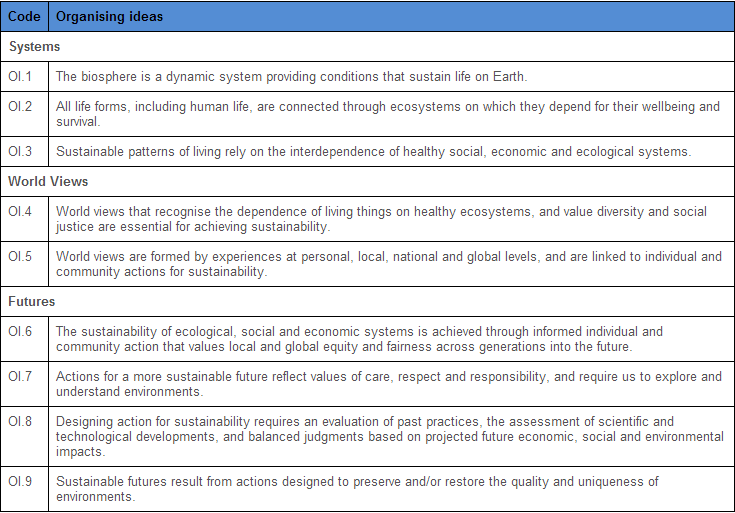
LEVEL This iQuest is designed for Grade 4 students or AusVels Level 4. DURATION The expected duration of this iQuest is one term or approximately 10-11 weeks. AusVels Sustainability Sustainability addresses the ongoing capacity of Earth to maintain all life. Sustainable patterns of living meet the needs of the present without compromising the ability of future generations to meet their needs. Actions to improve sustainability are both individual and collective endeavours shared across local and global communities. They necessitate a renewed and balanced approach to the way humans interact with each other and the environment. Education for sustainability develops the knowledge, skills, values and world views necessary for people to act in ways that contribute to more sustainable patterns of living. It enables individuals and communities to reflect on ways of interpreting and engaging with the world. Sustainability education is futures-oriented, focusing on protecting environments and creating a more ecologically and socially just world through informed action. Actions that support more sustainable patterns of living require consideration of environmental, social, cultural and economic systems and their interdependence. | 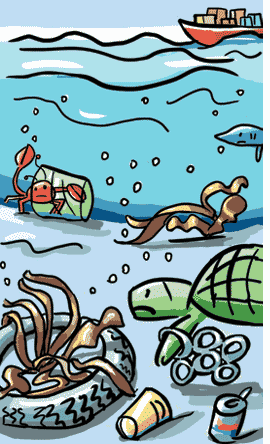 |
- In the Australian Curriculum: English, the priority of sustainability provides rich and engaging contexts for developing students’ abilities in listening, speaking, reading, viewing and writing.
- The Australian Curriculum: English assists students to develop the skills necessary to investigate, analyse and communicate ideas and information related to sustainability, and to advocate, generate and evaluate actions for sustainable futures.
- In this learning area, students may interrogate a range of texts to shape their decision making in relation to sustainability. They develop the understanding and skills necessary to act responsibly and create texts that inform and persuade others to take action for sustainable futures.
- In the Australian Curriculum: Mathematics, the priority of sustainability provides rich, engaging and authentic contexts for developing students’ abilities in number and algebra, measurement and geometry, and statistics and probability.
- Statistical analysis enables prediction of probable futures based on findings and helps inform decision making and actions that will lead to preferred futures.
- In this learning area, students can observe, record and organise data collected from primary sources over time and analyse data relating to issues of sustainability from secondary sources. They can apply spatial reasoning, measurement, estimation, calculation and comparison to gauge local ecosystem health and can cost proposed actions for sustainability.
- In the Australian Curriculum: Science the priority of sustainability provides authentic contexts for exploring, investigating and understanding chemical, biological, physical and Earth and space systems.
- By investigating the relationships between systems and system components and how systems respond to change, students develop an appreciation for the interconnectedness of Earth’s biosphere, geosphere, hydrosphere and atmosphere, Relationships including cycles and cause and effect are explored, and students develop observation and analysis skills to examine these relationships in the world around them.
- In this learning area, students appreciate that science provides the basis for decision making in many areas of society and that these decisions can impact on the Earth system. They understand the importance of using science to predict possible effects of human and other activity and to develop management plans or alternative technologies that minimise these effects.
SUSTAINABILITY IN HISTORY
- In this learning area, students appreciate that science provides the basis for decision making in many areas of society and that these decisions can impact on the Earth system. They understand the importance of using science to predict possible effects of human and other activity and to develop management plans or alternative technologies that minimise these effects.
- In this learning area, students appreciate that science provides the basis for decision making in many areas of society and that these decisions can impact on the Earth system. They understand the importance of using science to predict possible effects of human and other activity and to develop management plans or alternative technologies that minimise these effects.
AusVels Domains covered by this iQuest
The Arts
- Creating and Making:
- At Level 4, students create and present works in a range of arts forms that communicate experiences, ideas, concepts, observations and feelings
- Learning Focus:
- In Media, students plan, record and edit an interview with someone of interest (or curiosity) to them, then present their work and discuss ideas about it in class.
- Civic knowledge and Understanding:
- At Level 4, students explain why protection and care for the natural and built environment is important.
- Community Engagement:
- At Level 4, students work with other students to identify a local issue and plan possible actions to achieve a desired outcome. They describe the benefits of action at the local level and the democratic aspects of the process. They participate in activities to protect and care for the natural and built environment.
- Learning Focus:
- Students explore a range of aural, written and visual communication forms such as the Internet, film, texts and music which illustrate a variety of perspectives on a range of topics and ideas. They learn how to identify the main message, develop their own interpretation, and provide evidence to support it.
- During both formal and informal presentations, students explore the use of a range of verbal and non-verbal strategies, to enhance meaning and to engage their audience; for example, physical positioning in the room and use of props, costume, humour and audience participation.
- Reading and Viewing:
- Identify features of online texts that enhance readability including text, navigation, links, graphics and layout (ACELA1793)
- Investigate how quoted (direct) and reported (indirect) speech work in different types of text(ACELA1494)
- Writing:
- Incorporate new vocabulary from a range of sources into students’ own texts including vocabulary encountered in research (ACELA1498)
- Use a range of software including word processing programs to construct, edit and publish written text, and select, edit and place visual, print and audio elements (ACELY1697)
- Plan, draft and publish imaginative, informative and persuasive texts containing key information and supporting details for a widening range of audiences, demonstrating increasing control overtext structures and language features (ACELY1694)
- Speaking and Listening:
- Understand that social interactions influence the way people engage with ideas and respond to others for example when exploring and clarifying the ideas of others, summarising their own views and reporting them to a larger group (ACELA1488)
- Understand differences between the language of opinion and feeling and the language of factual reporting or recording (ACELA1489)
- Use interaction skills such as acknowledging another’s point of view and linking students’ response to the topic, using familiar and new vocabulary and a range of vocal effects such as tone, pace, pitch and volume to speak clearly and coherently (ACELY1688)
- Plan, rehearse and deliver presentations incorporating learned content and taking into account the particular purposes and audiences (ACELY1689)
- Learning Focus:
- Students investigate the human and physical characteristics of their local area and other parts of Victoria and consider features of their local community that have changed over time.
- They begin to make some simple comparisons between local and other Victorian environments: natural features, climate, land use and types of human activities. Students develop awareness and understanding of the effects of people's interactions with their environment and the ways in which these affect their lives.
- Learning Focus:
- As students work towards the achievement of Level 4 standards in Information and Communications Technology (ICT), they develop skills in using ICT for problem solving, expressing ideas, and presenting information to different audiences. Working in all areas of the curriculum, students explore a range of ICT tools (for example, basic editing tools such as word processing) and simple techniques for visualising thinking.
- Students begin to manage their files using simple ways of organising them for easy retrieval; for example, creating folders based on topics or forms such as stories, images, and projects.
- Learning Focus:
- As students work towards the achievement of Level 4 standards in Interpersonal Development, they interact with their peers, older and younger students, and adults in both informal and formal contexts. They develop their skills and strategies for getting to know and understand others within increasingly complex situations.
- In teams, students work towards the achievement of agreed goals within a set timeframe. With teacher assistance, they develop awareness of their role in the team and responsibilities in various situations, and interact with others accordingly. Students begin to be aware that different points of view may be valid. Using provided criteria, they reflect on the effectiveness of the teams in which they participate.
- Working in Teams:
- At Level 4, students cooperate with others in teams for agreed purposes, taking roles and following guidelines established within the task. They describe and evaluate their own contribution and the team’s progress towards the achievement of agreed goals.
- Measurement and Geometry:
- Use scaled instruments to measure and compare lengths, masses, capacities and temperatures(ACMMG084)
- Data Representation and Interpretation:
- Select and trial methods for data collection, including survey questions and recording sheets (ACMSP095)
- Construct suitable data displays, with and without the use of digital technologies, from given or collecteddata. Include tables, column graphs and picture graphs where one picture can represent many datavalues (ACMSP096)
- Learning Focus:
- Students participate in a diverse range of learning activities that allow them to acknowledge their development as learners. They monitor their learning through strategies such as share time and seeking feedback from the teacher and, where appropriate, their peers.
- With support, students develop strategies for managing their own learning, and identify the need for resource and time management in completing short tasks.
- Biological Sciences:
- Living things, including plants and animals, depend on each other and the environment to survive(ACSSU073)
- Use and Influence of Science:
- Science knowledge helps people to understand the effect of their actions (ACSHE062)
- Processing and Analysing Data and Information:
- Use a range of methods including tables and simple column graphs to represent data and to identify patterns and trends (ACSIS068)
- Evaluating:
- Reflect on the investigation; including whether a test was fair or not (ACSIS069)
- Communicating:
- Represent and communicate ideas and findings in a variety of ways such as diagrams, physical representations and simple reports (ACSIS071)
- Learning Focus:
- As students work towards the achievement of Level 4 standards in Thinking Processes, they explore aspects of their natural, constructed and social world, wondering and developing questions about it.
- They use a range of sources of information including observations and findings from their own investigations to answer these questions. Students develop strategies for organising and summarising information and reflecting on their thinking.
- Students participate in a variety of investigations and activities involving problem solving that encourage them to experiment with a range of creative solutions. They begin to reflect on the approaches they use to assist them to form their solutions.
- Reflection, Evaluation and Metacognition:
- At Level 4, students identify strategies they use to organise their ideas, and use appropriate language to explain their thinking. They identify and provide reasons for their point of view, and justify changes in their thinking.
Rational for this topic
The main idea for developing this iQuest was the growing issue of rubbish/pollution and its effects on our marine life. Sustainability plays an extremely important role in our future and is one that has been included in the new Australian Curriculum. It is an issue that can often get overlooked or seen as “too big” and “there’s nothing we can do about it”, when in actual fact there are many things we can do. It all starts with educating our children and showing them that the simple things, such as putting your rubbish in the bin and recycling can help make our world a better place.
This iQuest helps to show students that there are consequences to our actions and things we do can harm other species and also ourselves. We need to educate our children on how to take care of their world now so that it is still here in the future. The Captain Planet references made throughout are to reiterate the need for something to be done about this issue and to connect it to the younger generation who may enjoy the cartoon. Students of this generation may not be aware of Captain Planet, so this may be a great opportunity to show some episodes of the cartoon in class as they bring up many environmental issues that are still relevant in today's society.
Intended Learning Outcomes
The unit is aimed at providing real, connected, purposeful, challenging, authentic and meaningful learning experiences to lead to greater learning outcomes for all. The learning environment will be supportive and effective meaning that all students have the ability to grow and learn. The following learning aims are listed below:
- An understanding of why the ocean is important.
- An understanding of why our marine life is important.
- An understanding of how garbage affects our marine animals.
- The ability to see what needs to be done to stop this from happening in the future.
- The ability to see what we do at school to help.
- The ability to take on a role and portray a character confidently.
- The ability to research using the internet and other resources and how well you record and deliver that information for each role.
- The ability to work effectively as a team.
Thinking Processes and Skills
We designed this unit of work using the e5 instructional model in order to develop deep knowledge and understandings. This unit is designed to encourage children to move from lower-order thinking skills to higher-order thinking processes including:
|
• Making comparisons • Questioning • Managing information • Problem solving • Creative and imaginative thinking • Constructing explanations • Reasoning • Discovering relationships and connections |
• Critical analysing • Generating ideas • Conceptualising • Testing and exploring ideas • Drawing conclusions • Decision making • Reflecting |
What a Load of Garbage! iQuest Planning Table
Click HERE to open this planning table in PDF format.


Justification for using the 5e's model The e5 is an exciting and important instructional model that was launched in 2009 by the Victorian government. We chose to use this model in the development of our iQuest, as it is a great reference point for school leaders and teachers to develop a deeper understanding of what constitutes high quality teacher practice in the classroom. There are five phases, built around five active verbs: engage, explore, explain, elaborate and evaluate. Throughout the numbered tasks in our iQuest we have incorporated these five phases and integrated them into our tasks. In task one we engage with the ocean, so develop shared norms, determine readiness for learning, establish the learning goals, and develop metacognitive capacity. Task two we move into explore, so prompting and structuring inquiry as well as maintaining session momentum. Task three we explain, involving presenting new content in the form of an excursion, and also strengthening connections to the rich task. Task four is elaborating their knowledge, so cultivating higher order thinking, and also monitoring their progress so far. The final task five is the evaluate phase, assessing their performance against standards and facilitating student self-assessment in the form of a questionnaire. We hope that by scaffolding these phases it will all help link back to the development of their rich task. The most important thing about e5 is that it actually assists you to know where you’re at in your practice. You can self assess against the Continuum and know exactly where you’re located in terms of your proficiency level, and it gives you a sense of direction about those areas you can improve. We found it worked well with our iQuest development as it helped to keep us on task and focused with where we were up to and what needed to be done. | 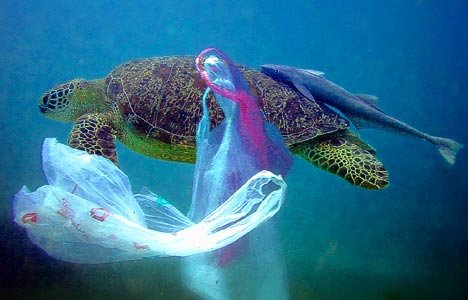 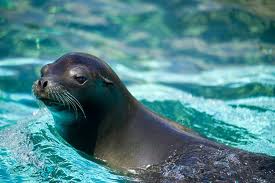   |
Assessment Strategies
Throughout our iQuest we have incorporated a variety of assessment tools and strategies to maximize student learning and outcomes. The three main ways we have included this assessment involves:
Assessment for learning- a combination of the teacher observing students, to monitor their progress throughout the iQuest as well as student and teacher feedback about how they found the iQuest. What worked? What didn’t work? In-order to improve future learning from the iQuest. Teachers are encouraged to complete the Teacher Assessment form to monitor the effectiveness FOR learning (Link found below).
Assessment as learning- allowing students opportunities to self reflect, self assess and also enhance their own learning outcomes.
Catering for inclusion
Our iQuest and rich task are designed to be completed in mixed ability groups, chosen by the teacher. Each person within the group has a specific role allowing individual students to excel in their task as well as participating as a team and working together. It is up to the teachers’ discretion whether the students choose their own role or it is allocated to them depending on their ability level. It is designed so that maximum learning outcomes for all students can be reached. If there are too many or not enough students for five per group, a higher-level student may take on two roles or an extra group member can be added and the roles shared in order to cater for inclusion.
